One of weeks 4's assignments is:
Analyzing the process whereby I write.
Writer's Notebook:
Write about... analyzing the process you routinely use when involved in writing activities, noting where you become discouraged or frustrated. To do this, you may identify the process, step-by-step, that you routinely use when involved in writing activities. Analyze your process, noting where you become discouraged or frustrated.
So, here is my analysis:
When I write, I just start writing. I do not use graphic organizers. I know how to teach using them and see their value, but for me personally the are a step I find excruciating in my won reading. I simply dig in and start writing.
As I write I go back and revise and check spelling, changing things around as I go. I probably got into this habit when I started being a frequent poster on message boards back when I participated in (and later moderated) the WDW AOL message boards in the late-90's. I then moved into e-groups, yahoogroups and then into the forums on Sonlight. Next up was facebook. When I write in those places I simply.... write. So, when I went back to college a few years and needed to write papers I just wrote.
Step by step:
1. Look at assignment
2. Think about it
3. Procrastinate about it
4. Clean some grout, organize a pile of papers which I've been meaning to get to for oh a long time
5. Open up word document and write.
6. Revise as I go
7. Get up and multi-task, go on facebook for a bit, check email, cook dinner, shower, all while pondering.
8. Get back to the writing project, finish it up.
9. Hit Spellchek
10. Submit.
Now, do I *teach* writing that way? No, I don't. Do I think that some kids write like I do, sure. But more enjoy the graphic organizers or need to learn to do it that way. Just as I was taught to rough draft/double space in handwriting and then copy the entire thing over.
You know what, ever single time I did that my finished copy was significantly shorter than my draft as who wants to copy over something again when it's long.
I distinctly remember being in 4th grade and writing a poem about butterflies. Mrs. Squires, my 4th grade teacher praised it, thought it was wonderful and some of my best writing ever. BUT she wanted me to go copy it over. I cut about half of it out. And then was even more upset when I found we had to do an art project and put the poem on the art. Why couldn't I just write and have my pretty poem the way it was. No, I had to do icky art (I don't like doing art and I can't anyway, so any art I do is icky, by it's very definition).
In any case, yes, I teach kids to draft and final copy. I have been taught that composing on the computer is an entirely different process/type of writing than handwriting the draft and then copy typing into final. Writing / composing on the computer is very fluid. It's a process where things can copy/paste/move/change.
Handwriting a draft and then laboriously copying it word for word be it typing or handwriting is a menial chore. Giving kids the choice to use the computer to compose is a gift of freedom.
Oh, did I wander? Fancy that.
Ok, so my process is that I start typing and am on topic and then my writing flows from there. And then I'm done. Can I explain it, not really. Can I analyze it. Sure.
1. Get the assignment.
2. Think about it.
3. Open word.
4. Start to write and see where it goes.
5. Graphic organizers aren't my thing.
6. Revising happens as I go, as does editing and rewriting.
7. The End.
I become frustrated when made to use graphic organizers. I become discouraged when asked to incorporate art into writing. I become discouraged and frustrated when placed in a box with no freedom to move the walls of the box to be more comfortable, to settle in and just write.
Monday, January 28, 2013

Descriptive Writing
Here is an assignment I'm working on:
Mini-Lesson: Description
a) Read the attached essay, "Where Worlds Collide" by Pico Iyer.
c) You are now going to write your own description. You can take something from your Stones in a River assignment -- or anything else. Take at least an hour to just write. You really want to use vivid details to evoke all our senses. Remember to "show, don't tell"!
This is part B "write some especially descriptive parts in your writer's notebook"
Mini-Lesson: Description
a) Read the attached essay, "Where Worlds Collide" by Pico Iyer.
Where Worlds Collide by Pico Iyer.doc
b) After you have read the essay, read this: Notice that the essay doesn't TELL us how a newcomer may feel. The essay DESCRIBES the environment into which a newcomer arrives (in this case, LAX airport). Go back and re-read the essay. Underline or highlight especially descriptive parts. Write some of them in your writer's notebook.c) You are now going to write your own description. You can take something from your Stones in a River assignment -- or anything else. Take at least an hour to just write. You really want to use vivid details to evoke all our senses. Remember to "show, don't tell"!
This is part B "write some especially descriptive parts in your writer's notebook"
they
come out, dazed, disoriented, heads still partly in the clouds,
bodies still several time zones—or centuries—away, and they step
into the Promised Land.
Around
them in an unending cacophony of antitheft devices, sirens, beepers,
and car-door openers; lights are flashing everywhere, and the man who
fines them $16.00 for losing their parking ticket has the tribal
scars of Tigre across his forehead.
Just
an undifferentiated smoggy haze, billboards advertising Nissan and
Panasonic and Canon, and beyond those an endlessly receding mess of
gray streets.
Sunday, January 27, 2013
Reading and Writing Thoughts
This past week I spent half days teaching various grades.
Wednesday was 4th in the morning and 2nd in the afternoon.
Thursday was a killer day. I taught kindergarten in the morning, 1st in the afternoon and then 4-10 pm I taught night-school high school math (with one period who had three students who didn't even attend night school in my class being disruptive. This day was certainly out of the ordinary.
Friday I taught 5th in the morning and 3rd in the afternoon.
The school in which I was subbing Wednesday through Friday was having "data digs" for half days. "Data digs" are where test results (MAPS or Scantron or other) are discussed on a child by child basis by the grade level teams and usually an administrator for at least part of the session and SPED teachers as needed.
In each class there was a literacy component. Well, not in my night school math class, but in my K-5 classes. It was great fun and good experience to teach all grade levels K-5 in a three day period. Seeing the low, middle and high performers in each group and using the same curriculum as a base gave me insight to how students learn to use higher level thinking regarding literacy in a way I hadn't been able to see before.
In the next few days, as I have time, I'll post some thoughts about what I learned.
Wednesday was 4th in the morning and 2nd in the afternoon.
Thursday was a killer day. I taught kindergarten in the morning, 1st in the afternoon and then 4-10 pm I taught night-school high school math (with one period who had three students who didn't even attend night school in my class being disruptive. This day was certainly out of the ordinary.
Friday I taught 5th in the morning and 3rd in the afternoon.
The school in which I was subbing Wednesday through Friday was having "data digs" for half days. "Data digs" are where test results (MAPS or Scantron or other) are discussed on a child by child basis by the grade level teams and usually an administrator for at least part of the session and SPED teachers as needed.
In each class there was a literacy component. Well, not in my night school math class, but in my K-5 classes. It was great fun and good experience to teach all grade levels K-5 in a three day period. Seeing the low, middle and high performers in each group and using the same curriculum as a base gave me insight to how students learn to use higher level thinking regarding literacy in a way I hadn't been able to see before.
In the next few days, as I have time, I'll post some thoughts about what I learned.
Essay on Authentic Writing v. Formulatic writing
This piece is a draft "argument" piece written for the prompt:
Educators should use authentic writing tasks rather than formulaic ones when teaching students to write.
Educators should use authentic writing tasks rather than formulaic ones when teaching students to write.
Have you ever written an assignment in which you had no interest? How about an assignment where you had no idea where to start or what the teacher was looking for? Now, have you ever written an impassioned email or facebook post or block post or letter in which the words fairly flew from your brain on to the page, post or site? Which writing was your better writing? The “what I did on my summer vacation” assignment or the writing on a topic of your choosing? These are the differences between formulaic writing and authentic writing.
Formulaic writing
is writing where the teacher says “you will all give me a three or
five paragraph essay with five to seven sentences in each paragraph
on the life cycle of the tse-tse fly.” Authentic writing is where
the teacher assigns the students to open a writing journal and write
for an amount of time, but the student determines the style of
writing and the topic of the writing. Which assignment would you
rather have? Which would your children rather have? Which is more
interesting to read?
Authentic writing
is what educators should use in the classroom. Authentic writing is
what adults use in the real world, it's the writing of grocery lists,
lesson plans, office memos, business letters and stories. In the
classroom authentic writing grabs the imagination of students and
helps them see the reasons “why we write” and to learn writing is
enjoyable. Once kids understand “why we write” it is far easier
to work with them on conventions of grammar, punctuation and spelling
than it is with a marked up paper that they hated writing in the
first place.
Small groups of
students focused on improving their writing, each working on a
similar task on different projects builds a sense of community and a
“hey, listen to what I wrote” and a “let me see what you
wrote.” All children writing the same (basic) essay on the same
topic leads to discussions of “are we done yet” or “only two
more sentences and I'm done.”
Students who are at
different parts of their writing share different experiences with
their classmates. Students learn best when some are finishing a
story and getting it read to “publish” which means show the piece
to others, be that taking it home, showing it to another teacher,
their classmates, or putting it in a class book. Students learn
best when writing at their own pace. In a writing workshop format,
any given student may be at the beginning, middle and end of the
writing process in any given class period. Using this model, some
students are revising, others editing, others having a mini-lesson
the teacher on “voice” or on adding more exciting adjectives and
verbs to their writing.
When students are
invested in their writing, writing something they are interested in
their writing improves and they take more care in the steps to final
product. Is there a place for worksheet writing? Yes, now and again
for certain tasks. But, for writing instruction on an ongoing basis,
authentic writing is the best way to go.
Monday, January 21, 2013
Prewriting
One of our assignments for week 3 of class is to "keep writing in our writers notebook." We also have reading assignments in three out of four of our texts.
Today I'm reading about prewriting in the Writing Workshop book by Ralph Fletcher and JoAnn Portalupi.
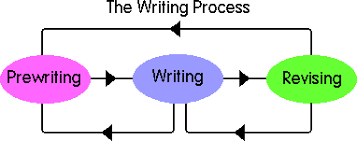
Prewriting often assigned by asking kids to use a circle map, graphic organizer of some sort, jotting down words, key word outline (my favorite of these) and thinking about what one wants write about. This is to keep the student from just blasting into writing without a plan (my preferred way of writing and what I do 98% of the time). However, as a teacher I do see the value of prewriting, even if I rarely (to never) use it myself.
We need to keep in mind that every student differs. Yes, I know we know that in theory, everyone does. But in practice teachers (homeschoolers or public/private school teachers) tend to follow a curriculum (or teacher driven) preference in prewriting. We tend to want to teach kids "the right way." But, there isn't a "one right way to prewrite." Some kiddos (and adults) thrive on graphic organizers. I see their use in classes, however personally I consider graphic organizers to be one of Dante's circles of hell. I hate the things (for my personal writing). They interrupt my flow, they are an extra step I find excruciatingly annoying and they do zip, nada, nothing for me in my writing process. Others swear by them.
Here is a quote from the book (page 63). "There are countless ways of rehearsing for writing. But too often in school the prewriting stage becomes a rigid routine. Instead of kids getting to choose how they want to rehearse for a piece of writing, all students are required to begin by making a cluster web, story map, outline graphic organizer."
The book goes on to say that prewriting should be a help, not a burden. The book suggests showing students a variety of ways to prewrite and letting them choose. Novel concept that. And Hallelujah and Amen.
I'm all for teaching graphic organizers and see their use (particularly in my field of special ed), but to insist that every child use them because the teacher decrees so inhibits some kids from writing at all. I find doing a graphic organizer harder than actually writing.
I'm also not a note taker, muddled through high school and college with very little to no note taking. Other than when teachers flat insisted we copy from the board. But that's another post. Others find note taking hugely important, even essential. The thing is, not every learner learns the same way. And we, as educators (be it public school, home school or private school) need to remember that and allow kids the ability to complete projects with freedom to get the job done in a way that suits them.
Prewrite - certainly. But some do that in their head as the type along, others need the graphic organizer, others are inspired by leafing through books or pictures for inspiration. One way does not fit all.
Today I'm reading about prewriting in the Writing Workshop book by Ralph Fletcher and JoAnn Portalupi.
Prewriting often assigned by asking kids to use a circle map, graphic organizer of some sort, jotting down words, key word outline (my favorite of these) and thinking about what one wants write about. This is to keep the student from just blasting into writing without a plan (my preferred way of writing and what I do 98% of the time). However, as a teacher I do see the value of prewriting, even if I rarely (to never) use it myself.
We need to keep in mind that every student differs. Yes, I know we know that in theory, everyone does. But in practice teachers (homeschoolers or public/private school teachers) tend to follow a curriculum (or teacher driven) preference in prewriting. We tend to want to teach kids "the right way." But, there isn't a "one right way to prewrite." Some kiddos (and adults) thrive on graphic organizers. I see their use in classes, however personally I consider graphic organizers to be one of Dante's circles of hell. I hate the things (for my personal writing). They interrupt my flow, they are an extra step I find excruciatingly annoying and they do zip, nada, nothing for me in my writing process. Others swear by them.
Here is a quote from the book (page 63). "There are countless ways of rehearsing for writing. But too often in school the prewriting stage becomes a rigid routine. Instead of kids getting to choose how they want to rehearse for a piece of writing, all students are required to begin by making a cluster web, story map, outline graphic organizer."
The book goes on to say that prewriting should be a help, not a burden. The book suggests showing students a variety of ways to prewrite and letting them choose. Novel concept that. And Hallelujah and Amen.
I'm all for teaching graphic organizers and see their use (particularly in my field of special ed), but to insist that every child use them because the teacher decrees so inhibits some kids from writing at all. I find doing a graphic organizer harder than actually writing.
I'm also not a note taker, muddled through high school and college with very little to no note taking. Other than when teachers flat insisted we copy from the board. But that's another post. Others find note taking hugely important, even essential. The thing is, not every learner learns the same way. And we, as educators (be it public school, home school or private school) need to remember that and allow kids the ability to complete projects with freedom to get the job done in a way that suits them.
Prewrite - certainly. But some do that in their head as the type along, others need the graphic organizer, others are inspired by leafing through books or pictures for inspiration. One way does not fit all.
Sunday, January 20, 2013
An Assignment on Argument
4. Now it's your turn! You are going to write an argument piece. Here is your prompt:
Educators should use authentic writing tasks rather than formulaic ones when teaching students to write.
Your task is to write an argument piece addressing this prompt.
One of the articles we read in advance of reading this assignment: Education Needs a Digital Age Upgrade. Other articles were about Argument v. Persuasion and an Argument Analysis handout.
I'll be writing my argument piece in a few minutes.
What do you think about term papers and the like? Archaic? Useful? What about technology in the classroom?
There is a stat quoted in the article that I've heard before, or at least the quote with various numbers. And it's true. It's been true since 1965 when I was in kindergarten and likely before that, but perhaps not so quickly. I started kindergarten in the mid-60's. We had mimeograph machines, punch card data entry things, computers the size of bedrooms, a black rotary phones wired to the wall and cameras which used film and flashbulbs. No ATMs, no debit cards, no VISA/Mastercard. We were taught in much the same way as our parents had been and that's still the way many students are taught, albeit with term papers typed up on the computer, or is that keyboarded?
Who would think that we'd grow up where phones, encyclopedias, cameras and friends would all live in our pocket? Where people "tele-commuted" google docs lets multiple people in different areas work on the same paper, where we'd shop on line.
Just as we couldn't imagine the world after we graduated, what was invented and what wasn't (based on predictions), we can't imagine what is coming along for the generation of our kids and grandkids.
Educators should use authentic writing tasks rather than formulaic ones when teaching students to write.
Your task is to write an argument piece addressing this prompt.
One of the articles we read in advance of reading this assignment: Education Needs a Digital Age Upgrade. Other articles were about Argument v. Persuasion and an Argument Analysis handout.
I'll be writing my argument piece in a few minutes.
What do you think about term papers and the like? Archaic? Useful? What about technology in the classroom?
There is a stat quoted in the article that I've heard before, or at least the quote with various numbers. And it's true. It's been true since 1965 when I was in kindergarten and likely before that, but perhaps not so quickly. I started kindergarten in the mid-60's. We had mimeograph machines, punch card data entry things, computers the size of bedrooms, a black rotary phones wired to the wall and cameras which used film and flashbulbs. No ATMs, no debit cards, no VISA/Mastercard. We were taught in much the same way as our parents had been and that's still the way many students are taught, albeit with term papers typed up on the computer, or is that keyboarded?
Who would think that we'd grow up where phones, encyclopedias, cameras and friends would all live in our pocket? Where people "tele-commuted" google docs lets multiple people in different areas work on the same paper, where we'd shop on line.
Just as we couldn't imagine the world after we graduated, what was invented and what wasn't (based on predictions), we can't imagine what is coming along for the generation of our kids and grandkids.
A Lesson on Voice
Yikes, a third post in one day? What's up with that?
Well, this is my writer's notebook and one of the assignments due tonight is to write about "Voice" in a couple of pieces in my Writers Notebook.
Granted, this is thoughts, ramblings, which just happen to be in a blog.
So, The Ashen Man and My Biker Initiation were assigned reading for us. The assignment is: Think and reflect: What details in this piece give us the voice? Write down words, phrases, or sentences from these essays that really demonstrate voice into your Writer's Notebook.
In The Ashen Man the description of the man and how he walks, looks, talks and how that differs from the normalcy which precedes his apperance in the store gives voice. Words like crisp, unrumpled, looked like a snowman, words of movement which give voice. The author uses many action words such as paused, froze, screamed and uses conversation with others, when the other is an observer to give voice to the piece.
In My Biker Initiation the use of descriptive words also gives voice. The author sets the dress of herself/companion apart from those of the bikers. she uses words like unholy congregation and describes her hat as something "between skull and tea cozy." At the end she compares the way the bikers were before the hat -- "stern, stone-faced" with "smiling, laughter like little boys" to show contrast.
The voice in both pieces contains contrast and very descriptive words/action verbs.
Well, this is my writer's notebook and one of the assignments due tonight is to write about "Voice" in a couple of pieces in my Writers Notebook.
Granted, this is thoughts, ramblings, which just happen to be in a blog.
So, The Ashen Man and My Biker Initiation were assigned reading for us. The assignment is: Think and reflect: What details in this piece give us the voice? Write down words, phrases, or sentences from these essays that really demonstrate voice into your Writer's Notebook.
In The Ashen Man the description of the man and how he walks, looks, talks and how that differs from the normalcy which precedes his apperance in the store gives voice. Words like crisp, unrumpled, looked like a snowman, words of movement which give voice. The author uses many action words such as paused, froze, screamed and uses conversation with others, when the other is an observer to give voice to the piece.
In My Biker Initiation the use of descriptive words also gives voice. The author sets the dress of herself/companion apart from those of the bikers. she uses words like unholy congregation and describes her hat as something "between skull and tea cozy." At the end she compares the way the bikers were before the hat -- "stern, stone-faced" with "smiling, laughter like little boys" to show contrast.
The voice in both pieces contains contrast and very descriptive words/action verbs.
Subscribe to:
Posts (Atom)